
Will Hearing Aids Make Me Look Old?

|
Marcie Jacobs, M.A., F-AAA
|
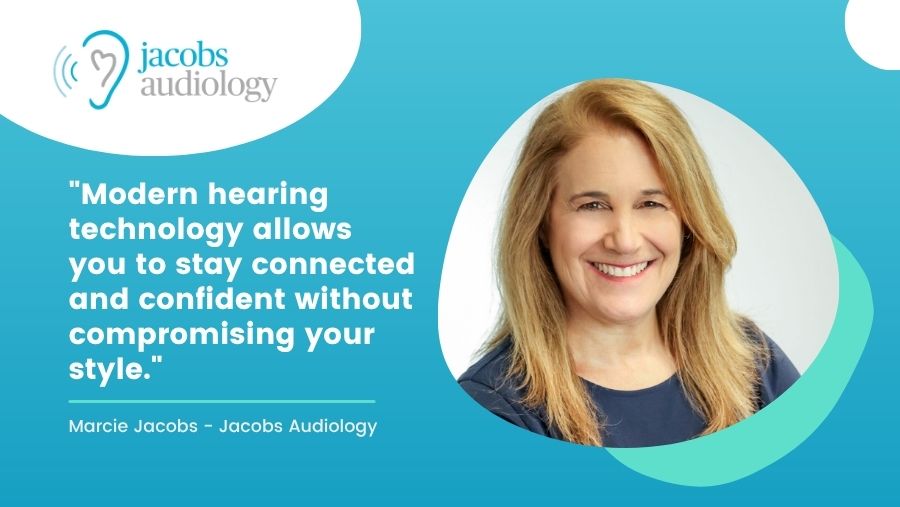
The decision to address changes in your hearing is deeply personal, and at Jacobs Audiology, we understand that aesthetic concerns often play a significant role in that choice.
You may find yourself hesitating to seek help because of a lingering image of what a hearing aid used to be: bulky, beige, and prone to whistling. It is completely natural to wonder if wearing a device will change how others perceive you or if it will serve as a visible marker of aging.
However, the reality of modern audiology has shifted dramatically. You benefit from a new era of technology where the focus is on seamless integration into your life, rather than the hardware itself.
When you choose to prioritize your hearing health, you are not choosing a sign of "getting older"; you are choosing to remain active, engaged, and fully present in every conversation.
Where the Stigma of Hearing Aids Begins
Your perception of hearing technology is likely colored by memories of older generations. Decades ago, hearing aids were limited by the vacuum tubes and large batteries of the time, resulting in devices that were undeniably conspicuous.
These older models often struggled to distinguish between background noise and speech and were prone to the high-pitched feedback that many people still associate with hearing loss.
This historical baggage often creates a barrier. You might find yourself withdrawing from social situations or nodding along when you haven't actually heard the speaker, all to avoid the perceived stigma of wearing a device.
Ironically, it is often these behaviors, the constant requests for repetition or the visible struggle to follow a story, that draw more attention to your hearing loss than a modern hearing aid ever would. You can rest assured that today’s solutions are designed to eliminate those social hurdles entirely.
How Modern Technology Has Changed the Conversation
You live in an age where wearable technology is the norm. From wireless earbuds to smartwatches, having a device in or on your ear is no longer a visual outlier.
Modern hearing aids have adopted this sleek, high-tech aesthetic. Many of the most advanced options are so small they sit entirely inside your ear canal, while others rest discreetly behind the ear, hidden by the contour of your hair or glasses.
Beyond their size, you benefit from incredible internal sophistication. Advanced digital listening devices now utilize artificial intelligence to process sound much like the human brain does. Instead of simply making everything louder, they sharpen the voices you want to hear and soften the environmental noise you don't.
Furthermore, you can enjoy the convenience of Bluetooth connectivity, allowing you to stream phone calls, music, and television audio directly to your ears. This transforms your hearing aid from a medical necessity into a versatile lifestyle tool.
Confidence Comes from Hearing Well, Not Hiding
True confidence is the ability to walk into a crowded room and know you can engage with anyone there. When you struggle to hear, that confidence often erodes.
You might feel a sense of isolation even when surrounded by family, or you may find yourself feeling fatigued after a simple dinner party because of the immense cognitive effort required to decode speech.
By addressing your hearing health, you regain your sense of self. You can participate in jokes, follow the nuances of a business meeting, and connect deeply with your loved ones without the stress of "filling in the blanks."
Many people discover that once they can hear clearly again, they actually feel younger and more energetic. The focus shifts away from what you are wearing and back onto who you are and what you have to say.
Choosing the Right Style for Your Lifestyle
Every individual has unique anatomical needs and aesthetic preferences. At Jacobs Audiology, we believe your technology should be as unique as your fingerprint.
If your primary concern is invisibility, you may be a candidate for invisible-in-the-canal (IIC) or completely-in-the-canal (CIC) styles. These devices are custom-molded to fit deep within your ear, making them virtually undetectable to those around you.
If you require more power or longer battery life, you might prefer a slim receiver-in-the-canal (RIC) model. These are designed with sophisticated finishes that mimic the look of high-end consumer electronics.
During your journey with us, you will find that our experienced hearing healthcare providers take the time to explain the pros and cons of each style, ensuring your choice aligns with your manual dexterity, your hearing requirements, and your personal style.
Why Professional Care Matters More Than the Device
While the device itself is important, it is only one component of your success.
You benefit most from a methodical and personalized approach to sound. This begins with detailed ear and hearing evaluations that go beyond beeps in the booth. We look at how your brain processes speech in noise and how your hearing loss affects your specific daily environments.
As an independent practice, Jacobs Audiology is not tied to a single manufacturer. This means you receive unbiased recommendations based solely on what will work best for you.
We provide ongoing support, fine-tuning, and counseling to ensure you remain confident in your technology long after the initial fitting. You deserve a partner who views your hearing health as a lifelong journey, providing a family-style atmosphere where your concerns are always validated.
Reframe the Question
Instead of asking, "Will hearing aids make me look old?" we encourage you to ask, "Will better hearing help me stay connected to the people I love?"
The most "youthful" thing you can do is stay engaged with the world around you. When you are ready to explore how modern technology can enhance your life, the team at Jacobs Audiology is here to provide honest, pressure-free guidance. We believe that your hearing health should empower you to live your most vibrant, connected life without any lingering hesitation.
You deserve to feel confident in every interaction, which is why we invite you to schedule your professional hearing evaluation today and discover how our personalized care can help you stay engaged with the world around you.
Frequently Asked Questions
Will people be able to see my hearing aids during a normal conversation? In most cases, no. Modern engineering has allowed for devices that are incredibly discreet. Whether you choose a custom-fit device that sits deep in the ear canal or a slim model that hides behind the ear, most people will never notice you are wearing them unless you point them out.
Furthermore, because these devices now look like high-end tech, even if they are seen, they are often mistaken for standard wireless earbuds.
Is it true that hearing aids are difficult to use and maintain as you age? You can rest assured that ease of use is a primary focus for manufacturers today. Many devices now feature rechargeable batteries, eliminating the need to fuddle with tiny disposable ones.
Additionally, many adjustments can be handled automatically by the device’s AI or through a simple app on your smartphone. At Jacobs Audiology, we provide thorough training and remote support to ensure you feel completely comfortable operating your technology.
If I only have trouble hearing in noisy restaurants, do I really need hearing aids yet? Difficulty hearing in background noise is often one of the first signs of high-frequency hearing loss. While you might feel you "get by" in quiet settings, the strain of trying to hear in noise can lead to significant mental fatigue and social withdrawal. Addressing the issue early allows your brain to maintain its ability to process speech, which can actually prevent more significant challenges down the road.
Source
Hearing Aids Technology and Styles
This dedicated page from the National Institute on Deafness and Other Communication Disorders provides a detailed breakdown of the specific discreet styles mentioned in the blog, such as IIC and CIC devices.